
August 31, 2026
The Markets
Artificial intelligence (AI) is driving the market and the economy.
Last week, markets experienced a burst of AI enthusiasm after a leading chip manufacturer’s earnings report exceeded expectations. The company anticipates revenue will grow by 70 percent over the coming year. Its shares advanced, as did shares of other AI-related stocks.
“The S&P 500 Index ended the session 0.7 percent higher…Meanwhile, the equal-weight version of the benchmark declined 0.3 percent, a reflection of the number of stocks falling despite tech’s strength,” reported Geoffrey Morgan of Bloomberg.
While investors cheered AI growth expectations, the Federal Reserve (Fed) considered what it means for inflation. Prices continue to increase faster than the Fed’s two percent per year target. Strong economic growth could make it harder to bring prices under control. In a speech last week, Fed Chair Warsh stated,
“Business capital expenditures—the seed corn of future economic growth—are rising rapidly… For firms in the S&P 500, profits have grown by more than 20 percent over the past year…But on the price-stability side of our mandate, the numbers are more concerning. The Fed’s preferred measure of inflation, the 12-month change in the PCE price index, stands at 3.7 percent, while the six-month change is 4.1 percent…Inflation is running above our 2 percent target. So the Fed’s predominant focus right now should be on prices.”
That commitment complicates the outlook for interest rates. AI is contributing to a surge in business investment, fueling economic growth. Faster growth is good for the economy overall, but it can make the Fed’s job of keeping prices stable more difficult. To bring inflation lower, the Fed may have to raise the federal funds rate. “As a rule of thumb, interest rates often need to be high enough to limit borrowing and spending to cool inflation,” reported Christopher Rugaber of the AP.
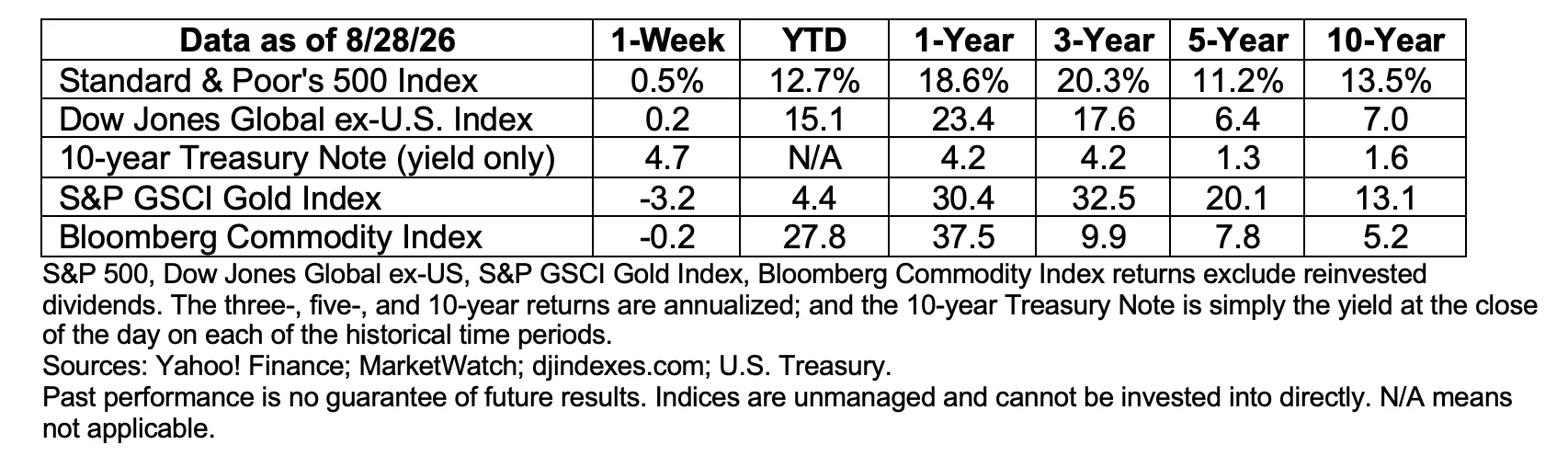
Last week, major U.S. stock indexes finished higher, although they gave back some gains late in the week. Yields on shorter maturities of U.S. Treasuries rose “in anticipation of rate increases as soon as next month,” reported Reuters. In contrast, yields on longer maturities moved lower.
HOW FAR WILL YOUR RETIREMENT SAVINGS TAKE YOU?
All vehicles are not created equal. A tank of gas will take a fuel-efficient or hybrid vehicle a lot further than it will take a gas guzzler. Retirement savings work in a similar way. Two people can retire with identical amounts of savings, yet the income they generate (and how long that income lasts) may be quite different.
A key issue is taxes.
“Millions of Americans spend decades saving for retirement only to trip over tax bills at the finish line. The shift from earning a paycheck to living off savings creates a new problem: figuring out how to turn assets into income without handing more than necessary to the IRS,” reported Suzanne Woolley of Bloomberg.
Fortunately, there are strategies that can help improve your tax efficiency. (Tax efficiency is making financial decisions that minimize your taxes.) Here are some points to consider:
- Your retirement income strategy should reflect you. Your strategy should be tailored to you. It will depend on the amount of savings you’ve accumulated, the types of accounts you have (taxable, tax-deferred, and tax-free), and the amount of income you need each year in retirement.
- Different types of accounts have different tax consequences. Your retirement savings may be in traditional retirement accounts (401ks and IRAs), Roth accounts, and taxable investment accounts. The tax consequences of withdrawals vary by account type, so retirees’ decisions about where to take income directly affect the amount of tax owed. Making thoughtful decisions about withdrawals can help reduce the amount of taxes paid in retirement.
- Roth accounts deliver tax-free income. Retirees may want to consider converting traditional retirement accounts to Roth IRAs. Income from Roth accounts is typically tax-free, as long as certain conditions are met. In contrast, income from traditional 401(k) and IRA accounts is usually taxable. In addition, when assets are in a Roth IRA, any future growth may be tax-free.
If an account owner moves money from a traditional account to a Roth IRA, the amount converted is generally taxed as ordinary income. Consequently, it’s important to consider whether the amount will push the taxpayer into a higher tax bracket. In general, Roth conversions are most beneficial during years when account owners are in lower tax brackets.
- Withdrawals from retirement accounts are required in your 70s. At age 73, the IRS requires Americans to begin taking required minimum distributions (RMDs) from traditional retirement accounts. (The age is 75 if you were born in 1960 or later.)
In some cases, RMDs exceed the amount retirees need for income during the year. When that happens, these distributions can be invested or donated to a qualified charity. The amount donated counts toward the RMD, but it isn’t included in taxable income.
The goal of retirement income planning is to have your savings provide income for as long as you may need it. If you have any questions, please get in touch.
This article has been prepared for informational purposes only. It is not intended to provide tax, legal or accounting advice. You should talk with your tax, legal and accounting advisors before engaging in any transaction.
WEEKLY FOCUS – THINK ABOUT IT
“Old age is like everything else. To make a success of it, you’ve got to start young.”
― Theodore Roosevelt, 26th President of the United States
Disclaimer:
* These views are those of Carson Coaching, not the presenting Representative, the Representative’s Broker/Dealer, or Registered Investment Advisor, and should not be construed as investment advice.
* This newsletter was prepared by Carson Coaching. Carson Coaching is not affiliated with the named firm or broker/dealer.
* Government bonds and Treasury Bills are guaranteed by the U.S. government as to the timely payment of principal and interest and, if held to maturity, offer a fixed rate of return and fixed principal value. However, the value of fund shares is not guaranteed and will fluctuate.
* Corporate bonds are considered higher risk than government bonds but normally offer a higher yield and are subject to market, interest rate and credit risk as well as additional risks based on the quality of issuer coupon rate, price, yield, maturity, and redemption features.
* The Standard & Poor’s 500 (S&P 500) is an unmanaged group of securities considered to be representative of the stock market in general. You cannot invest directly in this index.
* All indexes referenced are unmanaged. The volatility of indexes could be materially different from that of a client’s portfolio. Unmanaged index returns do not reflect fees, expenses, or sales charges. Index performance is not indicative of the performance of any investment. You cannot invest directly in an index.
* The Dow Jones Global ex-U.S. Index covers approximately 95% of the market capitalization of the 45 developed and emerging countries included in the Index.
* The 10-year Treasury Note represents debt owed by the United States Treasury to the public. Since the U.S. Government is seen as a risk-free borrower, investors use the 10-year Treasury Note as a benchmark for the long-term bond market.
* Gold represents the 3:00 p.m. (London time) gold price as reported by the London Bullion Market Association and is expressed in U.S. Dollars per fine troy ounce. The source for gold data is Federal Reserve Bank of St. Louis (FRED), https://fred.
* The Bloomberg Commodity Index is designed to be a highly liquid and diversified benchmark for the commodity futures market. The Index is composed of futures contracts on 19 physical commodities and was launched on July 14, 1998.
* The DJ Equity All REIT Total Return Index measures the total return performance of the equity subcategory of the Real Estate Investment Trust (REIT) industry as calculated by Dow Jones.
* The Dow Jones Industrial Average (DJIA), commonly known as “The Dow,” is an index representing 30 stock of companies maintained and reviewed by the editors of The Wall Street Journal.
* The NASDAQ Composite is an unmanaged index of securities traded on the NASDAQ system.
* International investing involves special risks such as currency fluctuation and political instability and may not be suitable for all investors. These risks are often heightened for investments in emerging markets.
* Yahoo! Finance is the source for any reference to the performance of an index between two specific periods.
* The risk of loss in trading commodities and futures can be substantial. You should therefore carefully consider whether such trading is suitable for you in light of your financial condition. The high degree of leverage is often obtainable in commodity trading and can work against you as well as for you. The use of leverage can lead to large losses as well as gains.
* Opinions expressed are subject to change without notice and are not intended as investment advice or to predict future performance.
* Economic forecasts set forth may not develop as predicted and there can be no guarantee that strategies promoted will be successful.
* Past performance does not guarantee future results. Investing involves risk, including loss of principal.
* The foregoing information has been obtained from sources considered to be reliable, but we do not guarantee it is accurate or complete.
* There is no guarantee a diversified portfolio will enhance overall returns or outperform a non-diversified portfolio. Diversification does not protect against market risk.
* Asset allocation does not ensure a profit or protect against a loss.
* Consult your financial professional before making any investment decision.
Sources:
https://www.bloomberg.com/
https://www.federalreserve.
https://apnews.com/article/
https://www.barrons.com/
https://www.reuters.com/
https://home.treasury.gov/
https://www.bloomberg.com/
https://www.
https://www.schwab.com/learn/
https://www.brainyquote.com/
Disclosure – All investment carries risk, and we cannot guarantee performance or results. Past performance does not guarantee future results. GIA does not earn any compensation from any of the non-GIA links provided in these resources. The market insights, podcast, blogs, book recommendations, self improvement thoughts, food recipes and activities are based on our perspectives and experience, and may not apply to your unique situation or be appropriate for your health and wellness. We are not aware of any conflicts of interest relating to any testimonials or endorsements. Please contact us for any questions relating to the content above, or to discuss how we can support you in your specific situation, and help you to reach your financial and personal goals.
Share This Story, Choose Your Platform!
Related Posts