

July 13, 2026
The Markets
America’s wealth looks different than it did just a couple of generations ago.
A lot has changed since 1989. Back then, there were no smartphones or streaming services. There wasn’t an app for anything. The first digital camera arrived the previous year, and the first handheld global positioning system (GPS) became available in 1989. While technology began reshaping everyday life, another change began unfolding, too.
Between 1989 and 2022, after adjusting for inflation, the wealth held by families in the United States almost quadrupled. It rose from $52 trillion (in 2022 dollars) to $199 trillion, according to data from the Congressional Budget Office (CBO). The composition of that wealth changed, too.
• Wall Street has become Main Street. More household wealth is invested in stocks than ever before. “Some 34 [percent] of US household wealth is now in stocks — the highest proportion on record,” reported Tracy Alloway and Joe Weisenthal of Bloomberg. “These are obviously aggregate figures, and equity ownership is skewed towards higher-income households. Nevertheless, this is a sea change in the composition of America’s total wealth, which was dominated for years (even after the bursting of the housing bubble in 2008) by real estate.”
• Retirement plans help grow household wealth. Years ago, a family’s wealth was largely tied to its home and, perhaps, a pension that would be paid by a company after retirement. Today, an increasing share of household wealth is in 401(k)s, IRAs, and brokerage accounts. Even people who have never thought of buying an individual stock may own thousands of companies through their workplace retirement plans. “In 2022, retirement assets and accrued Social Security benefits made up about 40 percent of [household] wealth,” reported the CBO.
• Diversification matters more than ever. With stocks comprising a bigger share of household wealth, managing risk is essential. One of the best ways to do that is through diversification, which means owning different types of investments that respond differently to changing market conditions. The idea is that one asset may increase in value when another is losing value. While diversification does not ensure a profit or protect against loss, it plays an important role in long-term investment strategies.
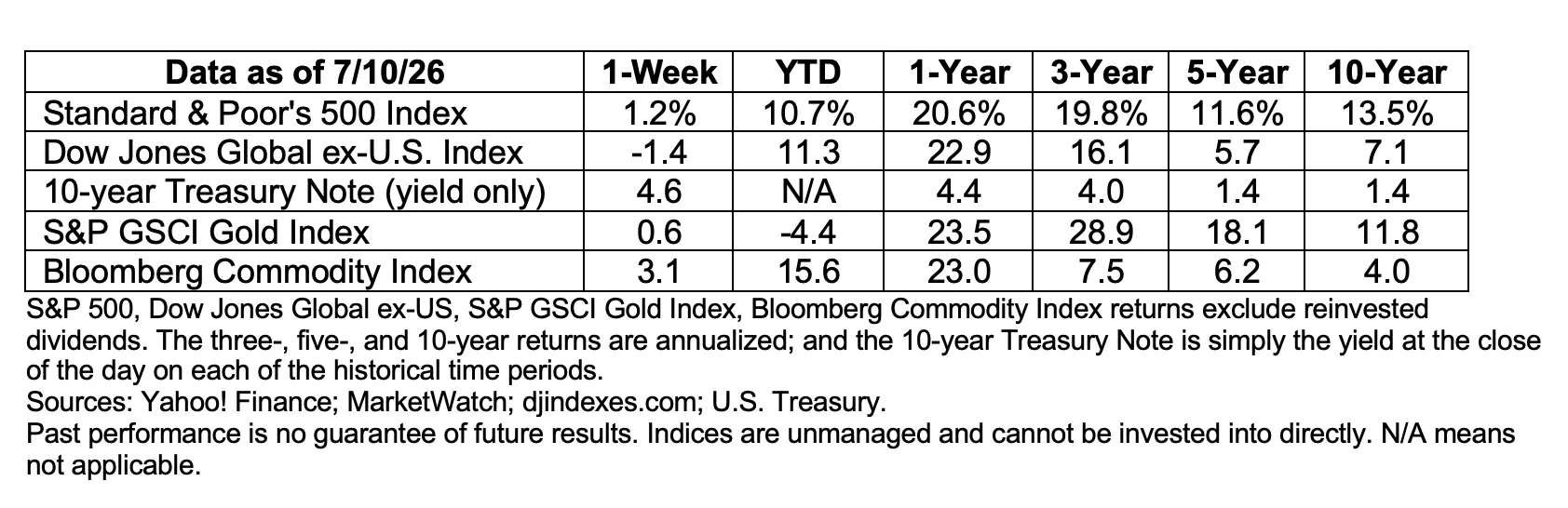
Last week, the Standard & Poor’s 500 and Nasdaq Composite Indexes finished higher. The Dow Jones Industrial Average lost ground, largely due to the collapse of the U.S.-Iran ceasefire, according to Teresa Rivas of Barron’s. Yields on mid- and longer-term U.S. Treasuries moved higher over the week.
WEEKLY FOCUS – THINK ABOUT IT
“We didn’t underestimate them, but they were a lot better than we thought.”
-Bobby Robson, Former professional soccer coach and player
Disclaimer:
* These views are those of Carson Coaching, not the presenting Representative, the Representative’s Broker/Dealer, or Registered Investment Advisor, and should not be construed as investment advice.
* This newsletter was prepared by Carson Coaching. Carson Coaching is not affiliated with the named firm or broker/dealer.
* Government bonds and Treasury Bills are guaranteed by the U.S. government as to the timely payment of principal and interest and, if held to maturity, offer a fixed rate of return and fixed principal value. However, the value of fund shares is not guaranteed and will fluctuate.
* Corporate bonds are considered higher risk than government bonds but normally offer a higher yield and are subject to market, interest rate and credit risk as well as additional risks based on the quality of issuer coupon rate, price, yield, maturity, and redemption features.
* The Standard & Poor’s 500 (S&P 500) is an unmanaged group of securities considered to be representative of the stock market in general. You cannot invest directly in this index.
* All indexes referenced are unmanaged. The volatility of indexes could be materially different from that of a client’s portfolio. Unmanaged index returns do not reflect fees, expenses, or sales charges. Index performance is not indicative of the performance of any investment. You cannot invest directly in an index.
* The Dow Jones Global ex-U.S. Index covers approximately 95% of the market capitalization of the 45 developed and emerging countries included in the Index.
* The 10-year Treasury Note represents debt owed by the United States Treasury to the public. Since the U.S. Government is seen as a risk-free borrower, investors use the 10-year Treasury Note as a benchmark for the long-term bond market.
* Gold represents the 3:00 p.m. (London time) gold price as reported by the London Bullion Market Association and is expressed in U.S. Dollars per fine troy ounce. The source for gold data is Federal Reserve Bank of St. Louis (FRED), https://fred.stlouisfed.org/series/GOLDPMGBD228NLBM.
* The Bloomberg Commodity Index is designed to be a highly liquid and diversified benchmark for the commodity futures market. The Index is composed of futures contracts on 19 physical commodities and was launched on July 14, 1998.
* The DJ Equity All REIT Total Return Index measures the total return performance of the equity subcategory of the Real Estate Investment Trust (REIT) industry as calculated by Dow Jones.
* The Dow Jones Industrial Average (DJIA), commonly known as “The Dow,” is an index representing 30 stock of companies maintained and reviewed by the editors of The Wall Street Journal.
* The NASDAQ Composite is an unmanaged index of securities traded on the NASDAQ system.
* International investing involves special risks such as currency fluctuation and political instability and may not be suitable for all investors. These risks are often heightened for investments in emerging markets.
* Yahoo! Finance is the source for any reference to the performance of an index between two specific periods.
* The risk of loss in trading commodities and futures can be substantial. You should therefore carefully consider whether such trading is suitable for you in light of your financial condition. The high degree of leverage is often obtainable in commodity trading and can work against you as well as for you. The use of leverage can lead to large losses as well as gains.
* Opinions expressed are subject to change without notice and are not intended as investment advice or to predict future performance.
* Economic forecasts set forth may not develop as predicted and there can be no guarantee that strategies promoted will be successful.
* Past performance does not guarantee future results. Investing involves risk, including loss of principal.
* The foregoing information has been obtained from sources considered to be reliable, but we do not guarantee it is accurate or complete.
* There is no guarantee a diversified portfolio will enhance overall returns or outperform a non-diversified portfolio. Diversification does not protect against market risk.
* Asset allocation does not ensure a profit or protect against a loss.
* Consult your financial professional before making any investment decision.
Sources:
https://medium.com/fbdevclagos/tech-timeline-30-years-and-beyond-1987-2017-8beef66255dc
https://en.wikipedia.org/wiki/Digital_camera
https://www.geotab.com/blog/gps-satellites/
https://www.cbo.gov/publication/60807
https://www.bloomberg.com/news/newsletters/2026-07-10/the-stock-market-and-a-phenomena-of-our-lifetimes? or go to https://resources.carsongroup.com/hubfs/WMC-Source/2026/07-13-26-Bloomberg-The-Stock-Market-And%20-%205.pdf
https://www.investopedia.com/investing/importance-diversification/
https://www.barrons.com/market-data?mod=BOL_TOPNAV or go to https://resources.carsongroup.com/hubfs/WMC-Source/2026/07-13-26-Barrons-DJIA-S&P-Nasdaq%20-%207.pdf
https://www.barrons.com/articles/stock-market-magnificent-seven-9a8da693?refsec=the-trader&mod=topics_the-trader or go to https://resources.carsongroup.com/hubfs/WMC-Source/2026/07-13-26-Barrons-The-Stock-Market-Cant-Afford%20-%208.pdf
https://home.treasury.gov/resource-center/data-chart-center/interest-rates/TextView?type=daily_treasury_yield_curve&field_tdr_date_value=2026
https://finance.yahoo.com/markets/commodities/articles/much-gold-hiding-world-cup-111438017.html
https://inside.fifa.com/organisation/media-releases/packed-stadiums-record-digital-reach-world-cup-2026-numbers-unprecedented-scale
https://www.si.com/onsi/athlete-lifestyle/2026-fifa-world-cup-prize-money-full-payout-breakdown-every-team
https://www.espn.com/soccer/story/_/id/49301582/us-men-women-get-equal-split-16m-world-cup-prize
https://variety.com/2026/tv/news/u-s-world-cup-loss-ratings-most-watched-soccer-telecast-1236806132/
https://www.si.com/soccer/how-much-do-world-cup-soccer-players-get-paid-usmnt-england-bonuses-explained
https://www.forbes.com/sites/brettknight/2026/07/01/the-numbers-behind-the-2026-world-cup/ or go to https://resources.carsongroup.com/hubfs/WMC-Source/2026/07-13-26-Forbes-The-Numbers-Behind%20-%2016.pdf
https://www.si.com/soccer/50-inspiring-soccer-quotes
Disclosure – All investment carries risk, and we cannot guarantee performance or results. Past performance does not guarantee future results. GIA does not earn any compensation from any of the non-GIA links provided in these resources. The market insights, podcast, blogs, book recommendations, self improvement thoughts, food recipes and activities are based on our perspectives and experience, and may not apply to your unique situation or be appropriate for your health and wellness. We are not aware of any conflicts of interest relating to any testimonials or endorsements. Please contact us for any questions relating to the content above, or to discuss how we can support you in your specific situation, and help you to reach your financial and personal goals.
Share This Story, Choose Your Platform!
Related Posts