
When people begin looking for a financial advisor, one of the first questions they often ask is,
“What do you charge?”
That is an important question, but it may not be the best first question.
A better place to begin might be: “What am I receiving for the fee I pay?”
Cost matters. Fees reduce investment returns, and every investor deserves to understand exactly how an advisor is compensated. But focusing only on the percentage can cause you to miss the larger issue. A lower fee is not necessarily a better value if you receive little proactive advice, rarely hear from your advisor, or make costly financial decisions without guidance.
As Tim Goodwin puts it:
“The cheapest financial advisor is rarely the best deal, and the most expensive advisor isn’t always the most valuable. The real question is: Are you receiving advice and comprehensive services that help you make better financial decisions and retire with greater confidence?”
The difference between cost and value
An advisory fee is a cost. Value is what that relationship helps you accomplish.
If an advisor simply selects investments and sends an occasional performance report, it is fair to ask whether the service justifies the fee. Investment management is important, but for someone approaching or living in retirement, it may be only one part of the financial guidance they need.
Comprehensive planning can help answer much larger questions:
- When can I retire?
- How much can I comfortably spend?
- Which accounts should I draw from first?
- When should I claim Social Security?
- Could a Roth conversion make sense?
- How might my income affect Medicare premiums or health insurance tax credits?
- How can I give generously without jeopardizing my own financial security?
- Is my estate plan coordinated with my investments and beneficiary designations?
The value of advice is not always found in a quarterly performance number. It can also appear in the taxes you may avoid, the risks you identify before they become problems, the decisions you make with greater clarity, and the confidence you gain from knowing that the pieces of your financial life are working together.
How do financial advisors get paid?
Financial professionals can be compensated in several ways, and the terminology can be confusing. Understanding the basic structures can help you ask better questions.
Asset-based fees
Under an assets-under-management, or AUM, arrangement, an advisor charges a percentage of the assets they manage for you. The dollar amount of the fee generally rises or falls as the account value changes and is often deducted from the account quarterly.
The important question is what the AUM fee includes. Does it cover only investment management, or does it also include retirement planning, tax planning strategies, cash-flow guidance, estate planning coordination, and ongoing strategy sessions?
Hourly or project-based fees
Some advisors charge by the hour or quote a flat fee for a defined financial planning project. This can work well for someone who needs advice on a particular issue rather than an ongoing wealth-management relationship.
We only offer this option for an hourly-based consulting when someone has less than $500,000 in investable assets. Goodwin Investment Advisory charges $375 an hour for this service.
Subscription or retainer fees
Some advisors charge a recurring monthly, quarterly, or annual amount for ongoing planning. The scope of services should be clearly defined so the client understands what is included.
Commissions
Some financial professionals are paid when a client buys or sells a financial product. Commissions are often associated with certain mutual funds, insurance policies, or annuities. Receiving a commission does not automatically mean the recommendation is inappropriate, but it creates an important question: Is the professional recommending this product because it is in your best interest, or because of the compensation it provides them?
We do not offer this option because we are fiduciaries and CFP® professionals, and we don’t sell any products. As a Fiduciary, the advisor has an obligation to make financial decisions and recommendations in the client’s best interest.
Fee-only versus fee-based
These terms sound nearly identical, but they do not mean the same thing. A fee-only advisor is compensated directly by clients and does not receive commissions for selling financial products. A fee-based professional may charge advisory fees while also receiving commissions from certain product sales.
Whichever model an advisor uses, you should understand how they are paid, whether any conflicts of interest exist, and when they are required to act as a fiduciary on your behalf.
Receiving good sound advice is worth it
Justin Pitcock, MBA, CFP®, recently met with a potential client couple we will call Scott and Jackie. He spent the first part of the meeting getting to know them, their goals, priorities, concerns, and complete financial picture.
From there, Justin showed them a potential strategy that could help them retire earlier than they had expected. Based on the assumptions used in the analysis, careful income planning could potentially help them qualify for nearly $20,000 per year in Affordable Care Act premium tax credits before they become eligible for Medicare. Their plan could also create opportunities to consider Roth conversions or realize long-term capital gains during years when their taxable income may be lower.
At the end of the meeting, Jackie said, “This all sounds great, but how do we pay for it?”
Her question revealed something important: they understood the potential value before they even understood the fee.
That does not mean fees are unimportant. It means financial advice should be evaluated in the context of what it may help you accomplish. In the right situation, coordinated planning can influence retirement timing, health insurance costs, taxes, income, charitable giving, and the sustainability of your long-term plan.
Strategies involving taxes and health insurance depend on individual circumstances, eligibility requirements, and current law. They should be evaluated with the appropriate financial and tax professionals.
The advisory fee may not be the only fee
One of the most important questions an investor can ask is, “What is my total cost?”
The advisory fee may be only one layer. Other potential expenses can include:
Mutual fund and ETF expense ratios
Funds generally have internal operating expenses that are deducted from fund assets. Investors do not usually receive a separate bill for these costs, making them easy to overlook.
Sales loads and distribution fees
Some mutual funds charge an upfront or deferred sales load. Certain funds may also include ongoing distribution or service fees, sometimes called 12b-1 fees.
Annuity and insurance expenses
Variable annuities and other insurance products may include mortality and expense charges, administrative fees, costs for optional riders, and expenses within the underlying investments.
Surrender charges
Some annuities and insurance products impose a charge when money is withdrawn or the contract is canceled during a specified period.
Trading, custodial, or account fees
Depending on the custodian, investments, and account arrangement, investors may encounter transaction charges, account fees, wire fees, or other expenses.
Layered advisory fees
In some arrangements, a client may pay an advisor fee as well as a separate manager, platform, or program fee. Ask whether multiple advisory costs apply to the same assets.
Even fees that appear small can have a significant effect when compounded over many years. This does not mean the lowest-cost option is automatically the right choice. It means every cost should be visible, understandable, and connected to a service or benefit you value.
What should you expect for an ongoing advisory fee?
Imagine that someone is paying an advisor approximately one percent per year. What should that person reasonably expect in return?
The answer depends on the agreement, but a comprehensive retirement-planning relationship may include:
- Retirement income planning
- Tax planning strategies
- Roth conversion analysis
- Social Security claiming analysis
- Medicare and IRMAA planning
- Investment management
- Cash-flow planning
- Risk management
- Estate and legacy planning coordination
- Charitable giving strategies
- Regular planning meetings
- Access to CFP® professionals
- Guidance during market volatility
- Behavioral coaching during emotional decisions
- Coordination with CPAs and estate-planning attorneys
- Planning through retirement, inheritance, widowhood, divorce, a business sale, and other major life transitions
Just as important, you should expect communication.
Before one of our clients hired us, she shared in her introductory call that she knew she was paying an advisor but did not know how much she paid, how often she paid it, or even how the fee was collected. She expected communication and advice but rarely received either. When she needed to know whether to take money from an IRA or a trust, she did not feel she had the guidance necessary to make the decision. She felt left in the dark about what her advisor was doing and why. She loved that we were so transparent with our fee structure and already felt seen and heard by our ease of communication and read on our client corner all the ways we communicate with our clients. She hired us really quickly after meeting with her advisor.
That should prompt a gut check. You should be able to understand what you are paying, what your advisor is doing, and how the recommendations connect to your goals. You should not have to wonder whether anyone is paying attention to your financial life, especially if you are paying for it!
Questions to ask your financial advisor
If you are unsure whether you are receiving enough value from your current advisor, consider asking these questions at your next meeting:
- How are you compensated, and what is my total annual cost in both dollars and percentages?
- Are there additional investment, product, platform, or third-party management expenses?
- Are you acting as a fiduciary at all times when advising me?
- What services are included in my fee?
- Do I receive a written retirement income plan?
- Have we discussed proactive tax planning strategies?
- Have you evaluated whether Roth conversions may be appropriate for me?
- Have we reviewed my Social Security claiming strategy?
- Have we discussed Medicare, IRMAA, or health insurance planning before age 65?
- How do you decide which account I should withdraw from in retirement?
- Do you coordinate with my CPA and estate-planning attorney?
- How often will we meet, and who should initiate those meetings?
- What will you do when markets become volatile?
- How will you help me adjust when my life, goals, or tax laws change?
- What is your plan for helping me retire with greater clarity and confidence?
- A trustworthy advisor should welcome these questions and answer them in language you can understand.
How Goodwin Investment Advisory charges
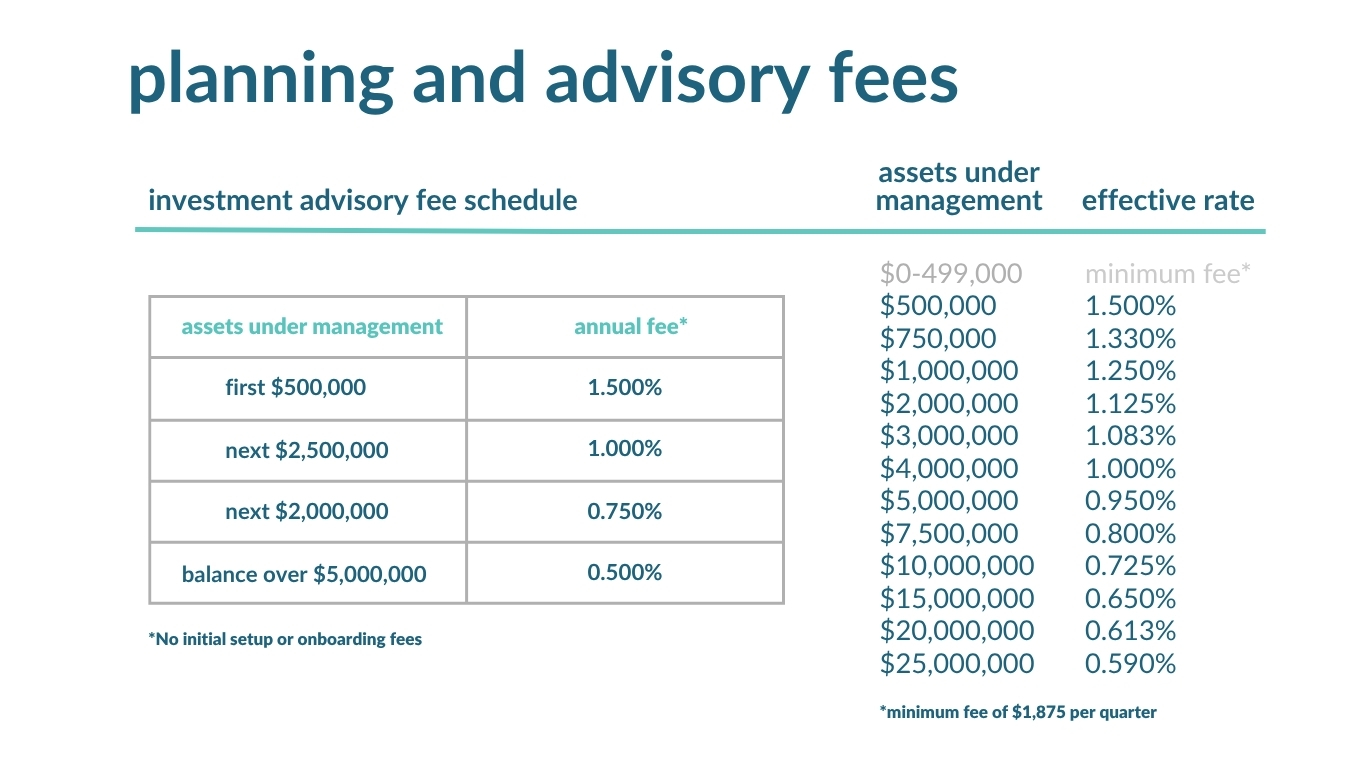
Goodwin Investment Advisory is a fee-only registered investment advisor. For ongoing wealth-management relationships, our fees are based on the assets we manage and are deducted from client accounts quarterly. Our effective fee rate decreases as assets under management increase.
You can view our current planning and advisory fee schedule here:
https://www.goodwininvestment.com/wp-content/uploads/2025/10/planning-and-advisory-fees.webp
Our goal is not merely to manage investments. We help clients connect their portfolios to a broader financial plan that considers retirement income, tax planning strategies, Social Security, health care, estate and legacy goals, charitable giving, risk, and the life transitions that can change everything.
Learn more about our financial planning services here.
Know what you pay and what you receive
If you have no idea what you are paying your financial advisor, or what you receive in return, it is time to ask.
Review your statements. Read your advisory agreement and Form CRS. Ask for your total costs in both dollars and percentages. Request a clear explanation of every service included in the relationship.
A financial advisor should not simply manage your investments. The right advisor should help you see the connections between your money and your life, anticipate important decisions, and help you move toward retirement with greater clarity and confidence.
The question is not only, “How much am I paying?”
The better question is, “What is this advice helping me accomplish?”
If you would like a second look at your current plan, your advisory costs, or the guidance you are receiving, schedule an introductory call with Goodwin Investment Advisory.
https://www.goodwininvestment.com/
Disclosure:
This material is provided for educational purposes only and should not be considered individualized investment, tax, legal, or insurance advice. The examples described are illustrative and depend on individual facts, assumptions, eligibility requirements, and applicable law. Consult the appropriate financial, tax, legal, and insurance professionals regarding your specific circumstances. All investments carry risk, and past performance does not guarantee future results. Registration with the SEC does not imply a particular level of skill or training.
Share This Story, Choose Your Platform!
Related Posts