
July 7, 2026
The Markets
The market spent the first half of 2026 floating like a butterfly.
The market slipped every punch during the first six months of 2026, and there were a lot of them: the Iran War, gyrating oil prices, rising inflation, changed interest rate expectations, employment concerns, and mounting national debt. Each issue stepped into the ring swinging and, while the market staggered occasionally, it recovered every time.
Teresa Rivas of Barron’s reported, “Bolstered by double-digit earnings growth, 2Q was the best quarter for the S&P 500 since the second quarter of 2020, and [we saw] the best first half of a year for the index since 2021.”
Here are some issues investors are watching as we head into the second half of the year.
- Winning on points. The United States economy had some mixed data rounds, but it appears to be solid. “Higher energy prices, stubborn inflation and widening inequality all pose risks that could erode the country’s current advantage,” reported Michelle Fleury of BBC. “Even so, compared with many other advanced economies, the U.S. continues to look robust. Its combination of flexible markets, rapid investment, abundant energy, and tolerance for risk has helped it weather shocks that have strained its peers.”
- AI prospects. Artificial-intelligence stocks have a shiny record, but will they prove out? Enthusiasm for AI and strong earnings lifted stocks to new highs, but the industry has been rocked by uncertainty. One issue is cost. The LLM Token Expenditure Index measures token price and usage. It doubled from December to May and is now down 20 percent from its May high, according to Jan-Patrick Barnert and Michael Msika as reported by Charles Riley of Bloomberg.
The move can be interpreted in different ways. “One explanation for the recent decline is that AI companies are losing pricing power with increasingly cost-sensitive customers, and that expectations for an eventual AI bonanza could prove misplaced,” according to Barnert and Msika. “Another read is that total spend has roughly doubled since last year and cheaper tokens have expanded the market. This means that an index pause is simply digestion, while demand is real and [capital expenditure] is money well spent.”
- A hostile crowd. An additional issue for AI companies is opposition to data center expansion. Over the first three months of 2026, more than 75 data-center projects valued at $130 billion were blocked or delayed because of grassroots protests. Many Americans dislike the energy demands, and environmental impacts of the enormous installations. “Public pushback is becoming a risk factor for AI companies and their shares,” reported Joe Light of Barron’s.
- Fresh legs in the ring. A market rotation has begun. As June came to a close, technology stocks fell out of favor, and investors began to find value in other market sectors, including healthcare, industrials, and financials, reported Barron’s. In addition, “nervousness about AI valuations has seen investors turning away from U.S. stocks at the fastest pace since March…Investors turned to some international stocks instead, with Japanese equities seeing their biggest inflows in seven weeks…,” according to sources cited by Andre Janse Van Vuuren of Bloomberg.
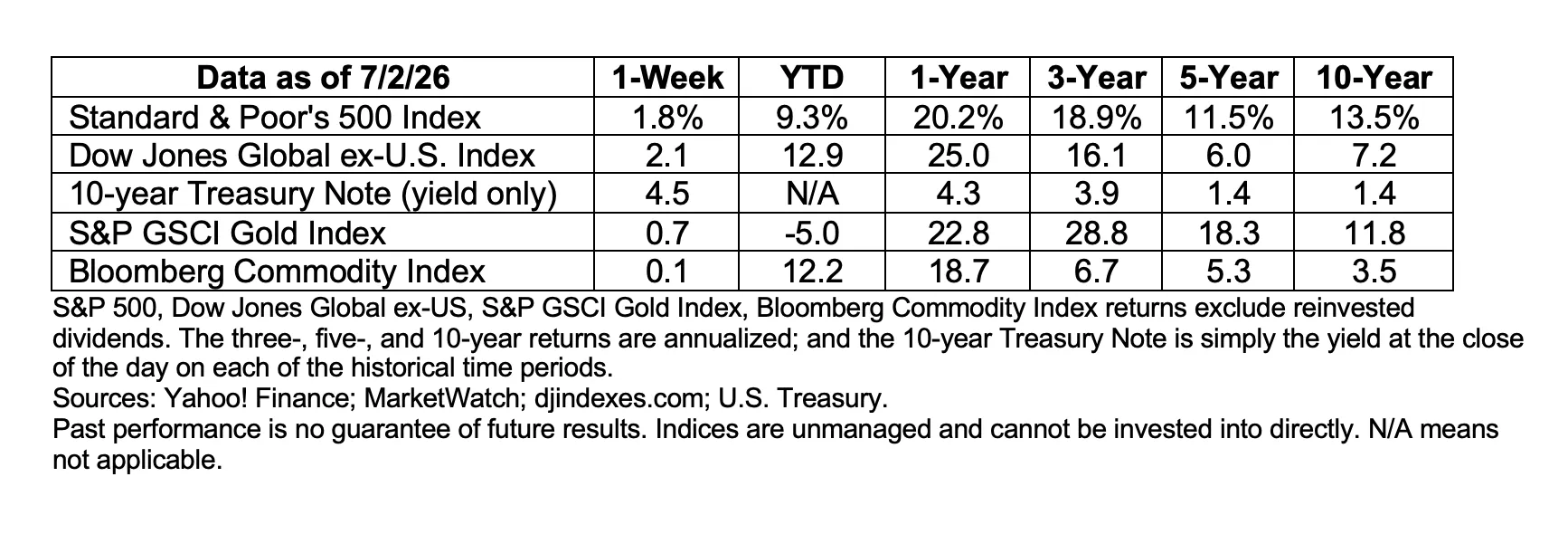
Last week, major U.S. stock indexes rose, and yields on mid- and longer-term U.S. Treasuries moved higher.
WEEKLY FOCUS – THINK ABOUT IT
“The social, and especially the political institutions of the United States, have, for the whole of the current century, been the subject in Europe, not merely of curious speculation, but of the deepest interest. We have been regarded as engaged in trying a great experiment, involving not merely the future fate and welfare of this Western continent, but the hopes and prospects of the whole human race. Is it possible for a Government to be permanently maintained without privileged classes, without a standing army, and without either hereditary or self-appointed rulers? Is the democratic principle of equal rights, general suffrage, and government by a majority, capable of being carried into practical operation, and that, too, over a large extent of country?”
– The New York Daily News, 1860
Disclaimer:
* These views are those of Carson Coaching, not the presenting Representative, the Representative’s Broker/Dealer, or Registered Investment Advisor, and should not be construed as investment advice.
* This newsletter was prepared by Carson Coaching. Carson Coaching is not affiliated with the named firm or broker/dealer.
* Government bonds and Treasury Bills are guaranteed by the U.S. government as to the timely payment of principal and interest and, if held to maturity, offer a fixed rate of return and fixed principal value. However, the value of fund shares is not guaranteed and will fluctuate.
* Corporate bonds are considered higher risk than government bonds but normally offer a higher yield and are subject to market, interest rate and credit risk as well as additional risks based on the quality of issuer coupon rate, price, yield, maturity, and redemption features.
* The Standard & Poor’s 500 (S&P 500) is an unmanaged group of securities considered to be representative of the stock market in general. You cannot invest directly in this index.
* All indexes referenced are unmanaged. The volatility of indexes could be materially different from that of a client’s portfolio. Unmanaged index returns do not reflect fees, expenses, or sales charges. Index performance is not indicative of the performance of any investment. You cannot invest directly in an index.
* The Dow Jones Global ex-U.S. Index covers approximately 95% of the market capitalization of the 45 developed and emerging countries included in the Index.
* The 10-year Treasury Note represents debt owed by the United States Treasury to the public. Since the U.S. Government is seen as a risk-free borrower, investors use the 10-year Treasury Note as a benchmark for the long-term bond market.
* Gold represents the 3:00 p.m. (London time) gold price as reported by the London Bullion Market Association and is expressed in U.S. Dollars per fine troy ounce. The source for gold data is Federal Reserve Bank of St. Louis (FRED), https://fred.stlouisfed.org/series/GOLDPMGBD228NLBM.
* The Bloomberg Commodity Index is designed to be a highly liquid and diversified benchmark for the commodity futures market. The Index is composed of futures contracts on 19 physical commodities and was launched on July 14, 1998.
* The DJ Equity All REIT Total Return Index measures the total return performance of the equity subcategory of the Real Estate Investment Trust (REIT) industry as calculated by Dow Jones.
* The Dow Jones Industrial Average (DJIA), commonly known as “The Dow,” is an index representing 30 stock of companies maintained and reviewed by the editors of The Wall Street Journal.
* The NASDAQ Composite is an unmanaged index of securities traded on the NASDAQ system.
* International investing involves special risks such as currency fluctuation and political instability and may not be suitable for all investors. These risks are often heightened for investments in emerging markets.
* Yahoo! Finance is the source for any reference to the performance of an index between two specific periods.
* The risk of loss in trading commodities and futures can be substantial. You should therefore carefully consider whether such trading is suitable for you in light of your financial condition. The high degree of leverage is often obtainable in commodity trading and can work against you as well as for you. The use of leverage can lead to large losses as well as gains.
* Opinions expressed are subject to change without notice and are not intended as investment advice or to predict future performance.
* Economic forecasts set forth may not develop as predicted and there can be no guarantee that strategies promoted will be successful.
* Past performance does not guarantee future results. Investing involves risk, including loss of principal.
* The foregoing information has been obtained from sources considered to be reliable, but we do not guarantee it is accurate or complete.
* There is no guarantee a diversified portfolio will enhance overall returns or outperform a non-diversified portfolio. Diversification does not protect against market risk.
* Asset allocation does not ensure a profit or protect against a loss.
* Consult your financial professional before making any investment decision.
Sources:
https://www.barrons.com/articles/stocks-today-ai-rotates-sectors-health-care-industrials-financials-28819289 or go to https://resources.carsongroup.com/hubfs/WMC-Source/2026/07-06-26-Barrons-Review-and-Preview%20-%201.pdf
https://www.bbc.com/news/articles/cwy031el03po
https://www.bloomberg.com/news/newsletters/2026-07-03/investors-track-tokens-for-clues-on-ai-trade-s-next-move or go to https://resources.carsongroup.com/hubfs/WMC-Source/2026/07-06-26-Bloomberg-Investors-Track-Tokens%20-%203.pdf
https://www.barrons.com/articles/ai-data-centers-backlash-stocks-8d564b5f or go to https://resources.carsongroup.com/hubfs/WMC-Source/2026/07-06-26-Barrons-Amerians-Hate-AI-Data-Centers%20-%204.pdf
https://www.barrons.com/articles/stock-market-rotation-things-to-know-today-f366b0b4 or go to https://resources.carsongroup.com/hubfs/WMC-Source/2026/07-06-26-Barrons-This-Market-Rotation-From-Tech%20-%205.pdf
https://www.bloomberg.com/news/articles/2026-07-02/stock-market-today-dow-s-p-live-updates?srnd=phx-markets or go to https://resources.carsongroup.com/hubfs/WMC-Source/2026/07-06-26-Bloomberg-European-Stocks-Rally%20-%206.pdf
https://www.barrons.com/market-data?mod=BOL_TOPNAV or go to https://resources.carsongroup.com/hubfs/WMC-Source/2026/07-06-26-Barrons-DJIA-S&P-Nasdaq%20-%207.pdf
https://home.treasury.gov/resource-center/data-chart-center/interest-rates/TextView?type=daily_treasury_yield_curve&field_tdr_date_value=2026
Disclosure – All investment carries risk, and we cannot guarantee performance or results. Past performance does not guarantee future results. GIA does not earn any compensation from any of the non-GIA links provided in these resources. The market insights, podcast, blogs, book recommendations, self improvement thoughts, food recipes and activities are based on our perspectives and experience, and may not apply to your unique situation or be appropriate for your health and wellness. We are not aware of any conflicts of interest relating to any testimonials or endorsements. Please contact us for any questions relating to the content above, or to discuss how we can support you in your specific situation, and help you to reach your financial and personal goals.
Share This Story, Choose Your Platform!
Related Posts