

Maximize Your Tax Savings with Strategies You Need to Know
Understanding how to manage taxes efficiently is crucial to growing wealth—whether you’re investing, planning for retirement, or managing distribution strategies. In this episode, Justin Pitcock shares actionable insights into tax loss harvesting, tax gain harvesting, and how sophisticated tools like SMAs can help you keep more of your money.
In this episode:
- What is tax loss harvesting and how can it be automated in your investment strategy
- The concept of tax gain harvesting and how to leverage your low-tax brackets
- The benefits of using Separately Managed Accounts (SMAs) for tax efficiency
- How to optimize your retirement distributions to avoid Medicare surcharges and maximize subsidies
- Practical examples illustrating how these strategies can save you thousands annually
Key Insights and Takeaways
- Tax loss harvesting involves selling investments at a loss to offset gains, with the ability to carry losses forward indefinitely—this requires intentional management, not just luck.
- The wash sale rule disallows repurchasing the same or substantially similar investments within 30 days to preserve tax-loss benefits, but strategic proxies (like ETFs) can be used effectively.
- Tax gain harvesting makes sense when your realized gains are within your 0% capital gains tax bracket, particularly for retirees. It’s about turning gains into tax-free opportunities.
- Unpackaged stock holdings through SMAs unlock more tax loss harvesting in diversified portfolios, especially when individual securities fluctuate independently.
- Using SMAs, including long-short strategies like AQR, can potentially increase tax loss harvesting opportunities by 30% or more during volatile markets.
- An intentional distribution strategy can reduce Medicare IRMA surcharges and maximize Obamacare subsidies—by carefully managing withdrawals from taxable and tax-advantaged accounts.
Goodwin Investment Tax Planning Services
https://www.goodwininvestment.com/services/tax-planning
Additional Resources:
https://www.goodwininvestment.com/10-pro-tax-planning-tips-for-early-retirees-w-justin-pitcock-part-1/
https://www.goodwininvestment.com/10-pro-tax-planning-tips-for-early-retirees-w-justin-pitcock-part-2/
Host Bio’s
Joe https://www.goodwininvestment.com/team-profiles/joe-beckford/
Tim https://www.goodwininvestment.com/team-profiles/tim-goodwin/
The following transcript of the podcast audio was software-generated, and not reviewed for accuracy. Therefore, the transcript below should not be used without verifying the validity and accuracy of its content. Please contact Goodwin Investment Advisory with any questions.
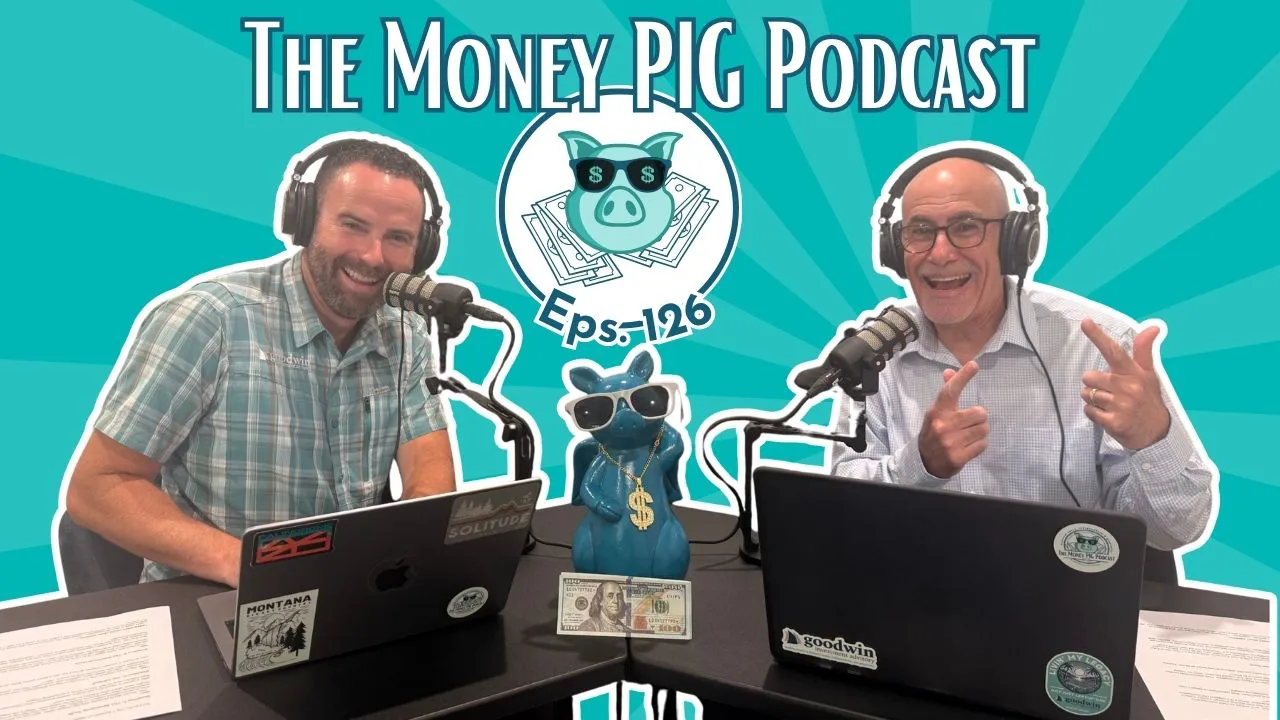
And welcome back to the money pig podcast. I am your host, Joe Beckford. is my very able bodied co-host. Yes. Age before beauty around here, everyone. Age before beauty. In case you missed a podcast episode where Tim didn’t make fun of my age, just stay tuned. It’s coming. Pretty much one every double down here. We have our special guest. If you can see, Justin is really not this small.
on the camera. He looks a little tinier at the end of the table. He’s flexing his financial muscle there. is the most ripped financial advisor you have ever heard of or seen. But if you’re watching this, he looks a bit smaller than you and me, Joe. That’s my secret weapon. He is small but mighty. Okay. Got to keep people safe around here. Yes. Thank you. Thank you, Justin. So we’re super excited to have you back. Today we are talking about…
Is your financial advisor saving you enough taxes? Wait a minute. Justin Pitcock is on the podcast and we’re talking about taxes. Isn’t that amazing? I am so shocked. Yeah, know. What would the topic be? Really, really. Took a side street on this one, everybody. This is Justin loves to talk about taxes. So we’re just going to let him share that love with you today. we’re going to buckle up, everybody. Buckle up, buttercup. So Justin, share something with our audience that they may not know about you.
So I’m writing a book and it may or may not be published by the time you’re listening to this. So and the title may or may not be it’s the tax smart wealth blueprint. Excellent. Excellent. That’s cool. And it would be on Amazon if it’s published by the time this go out. Yes, it’ll be on Amazon. It’ll be on for digital as well. So what will not be different, Justin, at that time will be your name.
Even if title of the book changes between now and the time it’s published, if you go to Amazon and you say Justin Pickock book, I think you’re probably going to just word tax. It probably has the word tax it somewhere. The tax smart will…
Wealth Blueprint. That’s going to be the title. So I’ve landed on that. OK, great. Well, they’re definitely going to find it. And we are grateful for you. to get us started with just a little more humor. Do you have a dad joke for Would you believe it? OK, so it took me a while because it really it was desperate trying to find anything that could be mildly funny as a tax joke. But I did think this was pretty interesting. And this is a shout out to Jamie from North Georgia CPAs. She’s been a guest on the show before and she’s had this in her newsletter and it’s better as a cartoon. But I’m going to kind of.
Try to explain it that if you put the words the IRS together and it spells one word, it’s theirs. the IRS basically spells theirs. That’s how it feels. Let’s change that. I like that. That’s why we got Justin here. Taxes are most people’s largest expense and we want to do what we can to change that. That’s a good point because initially you’re like, my mortgage is my largest expense, but you’re like, well…
after taxes. nope. yeah. He’s, they’re taking a lot your second largest expense. That’s a good, that’s a good point. Joe, what you got for us over there? It’s not about taxes, but I do have a dad joke. Let’s hear it, please. That’s roughly God help us. Did you hear about the new restaurant on the moon? Uh.
No joke. me about it. food, but no atmosphere. No atmosphere. Apparently there’s a Tesla floating around somewhere. Maybe you can Uber that sucker to get to that restaurant. But the atmosphere in here is perfect. We love that. That’s right. That’s right. It’s a good You’ll have no sad jokes. Yeah. Oh my gosh. That’s so great. I’m loving it. All right, Justin, let’s dive right in because that’s why the listeners came and listened and are viewing is for the tax savings. So, but we really did like it’s
There’s a long list of things and we spent some time before the show kind of picking some things that we thought might be a little more unique that we haven’t talked about a ton here on the Money Pig podcast. So we picked three different questions. So let’s start off with the first one. So you might have heard of tax loss harvesting before, and I think just in case listeners or viewers have not, I want you to unpack that. But I also want you to unpack what
tax gain harvesting is how they could do it themselves, but you know, mostly how we do it for our clients so they don’t have to worry about it. Gotcha. Yeah. So tax loss harvesting is where you let’s say you have an investment that is at a loss, you sell it, you realize that capital loss, and that can help you for tax purposes. So it’s it can offset a gain. So if you realize a loss on selling one investment,
and have an equal gain when you sell a different investment, they can offset each other, would net zero and pay zero tax. And you can bank these tax losses over time so that they can…
offset a future capital gain maybe years down the road. How long can you carry them forward? indefinitely until you die. It does not go to your beneficiaries. that’s not something that’s happening. My tax losses in my will. No, no, they go with you. I know. That’s right. Amazing. It’s because the IRS does let you get that free step up basis when you die. you know, it seems fair to me but
Well, yeah, exactly. You get that step up in the basis. It’s not going to do your beneficiaries any good anyway. Right. Gains and losses go away. So you can harvest those losses and you can roll them forward even if you can’t use them right away. Right. And so when you think of like, well, why should we, you know, why should we tax loss harvest or who is the ideal candidate for tax loss harvesting? It’s somebody who is who would need to realize capital gains in the future and not be at the 0 % capital gains rate. We’re going to talk about here in a second with tax or with tax gain, tax gain harvesting. So one other important thing with tax loss harvesting, you get if you don’t have a gain that it offsets, it will reduce your ordinary income like your W2 income, or pension income, IRA distribution, something like that by $3,000 a year. It’s not freaking inflation adjust that number. It’s been 30 grand forever. Maybe it one day, but every little bit helps. If your ordinary rates 22 % or whatever, then you’re reducing your taxable income by three grand, 22 % of that. It’s not a whole lot, but it’s Six, 700 bucks. adds up. So coming back to the tax loss harvesting before you move to gain harvesting.
I like to insert the word here, manufacture. You have to manufacture the tax loss harvest. You have to make it happen. They don’t really just happen on their own, unless you hire an advisor like us who’s doing it for you. And I guess my follow-up question there before we dive into tax gain harvesting is, well, Justin, it’s a good investment. I just bought it and the market just went down. So let’s say I sell it.
to realize the loss, but I still want to be in that investment. Right. You can’t buy back the same thing. There’s a wash sale rule. There’s 31 days on either side. So you have to have owned the investment for 31 days before you could sell it and get to use that loss to help you from a tax perspective.
And then you cannot buy that same investment back for 31 days, but not the same exact exact investment. How do we get around that? Just cannot be substantially similar. So, if you’re buying individual stocks, you could sell Home Depot and buy lows, similar businesses, but that’s different enough in the eyes of the IRS, which we’re not really.
recommending any particular stock on this show right now. That was just an example. That’s not a recommendation. was just an example. Another more common thing I think for our clients would be like selling a S &P 500 ETF. It would violate the wash sale rule if you sold one S &P 500 index ETF and bought another one. That’s the same thing. It’s the same underlying.
But what would be different if you sold the S &P 500 ETF and bought a total US stock market ETF that includes small and mid cap S &P 500 is only large cap. its performance is going to be basically the same. Yeah. So you can get into a substitute proxy and then 31 days later you could switch back to what you got out of or if you’re okay with what you have going a total market ETF versus S &P 500 ETF.
basically the same expected performance. Let’s say you had done a bunch of research and you had decided to pick Home Depot, but it dipped after you bought it. You want to harvest that loss. You get into something like Lowe’s, you’re not at the time. This is real companies, but just hypothetically speaking, you want to be back in Home Depot, but for 31 days, can go back. Exactly. So tell us about what tax gain harvesting is. Why on earth would you manufacture a gain that you weren’t ready to spend?
So tax loss harvesting is like turning lemons into lemonade. Tax gain harvesting is well, just lemonade to begin with. You’ve already got the juice. So tax gain harvesting has to do with when your income from those realized gains is taxed at the 0 % tax rate. So most people are familiar with the different tax brackets.
that’s specific to your ordinary income. There’s a whole separate set of tax brackets for capital gains rates. That’s the long-term capital gains rate. And for a couple that’s married filing joint, it’s pretty close to $100,000. capital gains are taxed at their special rate and…
the income from long-term capital gains stacks on top of your ordinary income. So let me give you an example. Think of a retiree that’s between the couple, they’ve got $60,000 a year of social security income, and they have no other ordinary income. Well, they rebalance their portfolio and realize $40,000 of long-term capital gains. That stacks on top of their 60,000 of social security income.
and that $40,000 of long-term capital gains is taxed at 0%. Because the total is under $100,000. Exactly. So you don’t want to miss that. You don’t want to go through the whole tax year. You made the $60,000, you had all these gains in taxable accounts, you could have gone and manufactured a gain and paid no taxes on that $40,000 in your example. Exactly. knowing your situation, and actually you have more runway than that because it’s…
It’s not based on your gross income. It’s based on your taxable income. And that’s after all of your deductions. So let’s just say you’re taking the standard deduction. It’s a little over $30,000. So really, you could have income up to about $130,000. Because you’re taking the standard deduction. Because you take the standard deduction that brings it down. And so all the gains that fit in there would be taxed at the 0 % rate. Now, above that, does above $100,000 is it go to $15,000?
Then it goes to 15. Yeah. Yeah. And you know, if you have state income tax like we do in Georgia, then you’re adding another six ish to that, right? So you go from zero to like 21. Does Georgia state income tax apply to that under a hundred thousand? so Georgia doesn’t have an exclusion for capital gains, like capital gains and ordinary incomes, tax the same as in Georgia. right. So, so you’re already going pay the six either way, but you basically, my point is you go from zero to 15%. Federally.
Federally, yeah over the hundred thousand. So it’s a big deal. There’s another one that we sneak in here real quick, too I’ll mention before we go to the next question is When you have an UTMA or an UGMA, so these are custodial brokerage accounts, but we’re having situations where maybe grandparents are ⁓ funding a custodial account for a grandkid and and if you’re doing that over time you get to build these gains in there, but this the first certain amount of gains and they happen inflation adjusting that number I think
⁓ goes is free and then the next group is that the child tax bracket which if it’s a young grandkid they’re not making any money and so that can also be free too so it’s important to even consider that like young in life to manufacture the gain and maybe you know when you’re under the hundred thousand dollar there’s an exclusion amount and then there’s amount that’s at the child’s rate when you those together it’s about twenty six hundred dollars a year and so it’s that’s
that gives you an opportunity in these custodial accounts to just reset that basis because when that money becomes fully theirs when they reach the age of majority and they need that money to go to college or buy their first car, whatever it may be, if you’ve upped their basis along the way, then they pay less and in tax. So there’s less tax drag. That’s the way I like to phrase it. Right. Awesome.
So Justin, we want to talk about something that most people might not be aware of or what it is. Something called an SMA, right? So I’d like you to unpack a little real briefly, what is an SMA? But more broadly, how would we use an SMA to unlock really tax efficiency? an SMA stands for separately managed account. And you may think, well, gosh, like
aren’t all of my accounts separately managed? yeah, it kind of makes sense. But an SMA allows for a lot of customization. let’s first start with like a traditional portfolio of mutual funds and ETFs. Maybe you’ve got a well diversified portfolio, you use a dozen or so funds, and then an SMA would be like taking all of the underlying stocks and bonds that make up those funds and just unpacking them. So now you own
potentially hundreds, could even be over thousand individual stocks and bonds. That sounds like a big monthly statement. Here’s your 200 page monthly statement with your individual securities. Do not print your In order to use these SMAs, you normally have to agree to electronic delivery. They’re not going to send you. So from a tax loss harvesting standpoint, this SMA
is like your portfolio of mutual funds unpacked into all these different individual stocks and bonds. There’s a lot more tax loss harvesting opportunities. think to go back to one of the examples that you gave earlier, because you were saying with tax loss harvesting, the difference between like Home Depot and Lowe’s or the ETF or mutual fund of the S &P 500 and more of a total market one. So a lot of folks have a diversified portfolio of mutual funds. There’s a lot of wisdom there. There’s low cost there.
index funds, ETFs, active funds, whatever. And so you’re not really picking individual stocks, but you’re picking mutual funds. And you’ve got kind of a basket of mutual funds. Most people have this kind of thing in their 401k, but maybe you’re doing this in your taxable accounts as well. This is just for, or primarily for taxable accounts. Absolutely. There could be reasons you do it with tax sheltered accounts like an IRA or Roth. But primarily what we’re talking about here is doing this in taxable accounts for the extra tax benefit. Exactly.
So what Justin’s saying here about SMAs is the difference is that individual stock, the volatility of like home depot and Lowe’s independent of each other and outside of a fund is way more dramatic. And so when you unpack potentially a taxable account versus, hey, I just had this diversified portfolio mutual funds, but now I’m going to turn it into an SMA of, like you said, hundreds, if not thousands of securities. Well, those individual securities can have much more substantial losses and gains than when they’re all averaged into one big.
Exactly. So let’s just think of the S &P 500 as a good example. You could own this S &P 500 index fund, and if the whole market took a dip, you could tax less harvest and move into a total market index fund. Yeah, and that never happens. I the S &P 500 never takes a dip, right, Joe? At least once a year. Just to be clear. If you owned the individual stocks that make up the S &P 500 on any given day, They’re going for dips.
Well, normally half of them are up, of them are down. So you’ve got a lot more opportunity here to just consistently tax loss harvest. So Justin, what would you expect? So, okay, so the benefit is we’re going to tax loss harvest, I’m going to be able to bank a lot of losses and we can carry them forward indefinitely, right? So if I’m going to…
sell a business, I’m going to sell a piece of real estate or something down in the future, I’m thinking, wow, I should be banking some losses now because I’m going have a big, we call them liquidity events around here now, right? So Justin, you’re my advisor and you’ve taught me into this because this is a great idea. I’m going to get a bunch of tax loss harvesting and all we’ve talked about is loss, loss, loss, loss. How do I expect my investment to perform though? I still want to make money, right? If we’re trying to mirror the S &P 500 and the SMA,
pretty darn close to whatever the S &P 500 does, if you’ve unpacked it into the SMA. Plus or minus, I’d say one, one and a half percent, but the technology’s good enough here that we would use for these SMAs. It’s going to track pretty darn close to what the target index is. So you’re basically saying I don’t have to sacrifice performance to bank these losses. Exactly.
And I can use an example and I’ve got to think through my chief compliance officer filter here, but one of the SMAs that we do for clients is called AQR. And one of the clients that got into this strategy last year had actually come from realizing a large gain, selling a real estate piece of property. And so we were able to get him in the strategy early enough that with these individual securities, like Justin’s saying, half of them are going for dips every day.
and being able to harvest some of those, we were actually in a manufacturer losses between when he sold the building in the end of the year, even though that account kept up with the performance of the index that we were trying to match for the SMA. So he was able to essentially take those proceeds, about a million dollars, put it into AQR and keep up with market conditions and all along the way harvested some losses. And I can’t remember the exact amount, so I’m not going to.
in that example, but but often that can be 30, 50, $70,000. So with some of these strategies, yeah, let me work through kind of some expectations here. So if you were invested in just a mutual fund portfolio, like that, that those mutual funds are going to spit out capital gains distributions, you may need to rebalance to manage your risk well. And most studies show that your tax drag is averaged out around one and a or 2 % annually.
of your total performance. Right, because you got to make you got to pay tax. Right. So if your mutual fund portfolio earns 10, like net of taxes, you’re getting roughly, you know, eight, eight and a half. Now, if we did a ETF portfolio, ETFs are a little bit more tax efficient. I know that’s not what we’re focused on with this podcast. But you don’t have capital gains distributions with ETFs. So they’re a little bit more efficient. We’re talking probably a tax drag of
⁓ half to 1%, so 9 or 9.5%. Now we can go to this direct indexing, these custom SMAs that we’re talking about. That brings our tax drag down around probably 0.2%. So you’re getting pretty close to whatever that market performance is. You’re still going to have dividends that are creating. Still dividends that are going to create some sort of tax liability, and that’s why it’s not zero.
what you were talking about with AQR, that is a little bit more sophisticated than the traditional direct indexing or custom indexing SMA. That is a long short strategy. basically you’re adding on a long extension and a short extension to existing portfolio of basically borrowed money. Your tax loss harvesting on a larger portfolio amount.
for lack of better terms here that everybody will understand, it’s kind of like you’re tax loss harvesting on more money than what you came to the table with. It doesn’t mean you’re taking more market risk here, but it creates a huge opportunity for tax loss harvesting. So if you’ve got a million bucks in a strategy, and a long short strategy like AQR, it’s reasonable to think over 12 months you could tax loss harvest approximately 30%.
Now with a straight long only direct index SMA, probably around 10, 15%. The more volatile the market, the better. And it could go up to maybe 30%, but that’s going to take some good market volatility to get you those type of results. There’s something you don’t usually hear, good market volatility. I know, interesting.
That was the deep part. Yeah, you thought we were jumping into the deep end of the pool. You got a little deeper heading for you. We’ll wake you back up and switch to the next question. But that’s a really great point, Justin. we certainly on the SMAs, mean, you know, we have some of these that we have vetted for our clients. then I think, like, I don’t know, like to retail to folks without financial advisors, can they get in touch with custodians about.
The SMAs they have available. Some, yes. There’s a lot of institutional strategies that only advisors are going to have access to. With a long short strategies, there’s negotiated margin rates that’s like where there’s a lot of value in going through an advisor and they’re not, these are very sophisticated strategies and you need somebody in your corner to work through that with you. Do not try this on your own. Do not try this at home. Do not try this at home kids. We adult supervision.
Okay, so last question here, Justin, this kind of pivots substantially away from this kind of tax lost and tax gain harvesting and SMA strategies, but more about the distribution strategy. And so we’re talking about when you’re not when you’re accumulating and trying to do all these things necessarily, but maybe you’re there, you’re in retirement, you’re distributing, maybe you’re semi retired, or you know, you’re part time retired, gradually retiring. But we’ve realized that the distribution strategy, whether you’re pulling from tax
free like Roth or tax deferred like traditional or taxable accounts, that that mix of distribution can have a significant impact on health insurance premiums where you’re not getting subsidies anymore, or maybe you’re getting premium surcharges on Medicare that’s called IRMA, right? The acronym there. So maybe just walk us through, you don’t have to go into quite as much detail as the SMAs, but just overall,
Why is it important to be intentional about your distribution strategy when it comes to things like health insurance premiums? So I think that’s a great example to lead with. Actually, earlier today I was in a meeting with a couple and they’re retiring at 60. Medicare starts at 65. They need health insurance for the next five years. And the ACA plans, the Affordable Care Act plans, come with a really big subsidy.
if your income, your modified adjusted gross income is low enough. That doesn’t mean your total income, because Roth distributions don’t count. The principal from your taxable account, your brokerage account, that doesn’t count. So we crafted a plan where basically they needed about $160,000 a year after tax to cover their cost of living.
But we had to keep their modified adjusted gross income below $84,000. So what are we going to do? We’re going to pull about $50,000 from an IRA. That all counts towards that $84,000 MAGI number that I’m talking about. We’re going to pull some from their brokerage count and the rest from Roth. We’re going to be able to get them $160,000 a year. Meanwhile, their MAGI is going to stay below $84,000.
They’re going to get for the couple combined about a $20,000 tax credit from the government. Isn’t that crazy? So it’s amazing. So you’re not doing it this way. It’s real money. Yeah. And they need, you said, what is that, that 160 that they? They need it. They need 160. they brought all that in as taxable. They’d be leaving 20 grand of tax And they’re going to this for five years. That’s a hundred grand of free money. mean, we’re all paying for it. Free to them. Redistributed wealth.
Yeah, so that’s really, really powerful too, is just to make sure that you’re aware of what your distribution strategy is. Certainly, if you’re on the Obamacare platform with the subsidized health insurance, or if you’re on Medicare. There’s a ton of examples. That’s the biggest one. But things like managing your Medicare premiums, Part B and D come with a, you pay a premium and there’s a surcharge called IRMA if your income is too high. So like, just
the distribution strategy comes into play here. Let’s not cross that threshold where you have surcharges. Other things like avoiding what we call the social security tax torpedo. Some people are in a situation where we can lower their income enough on paper so that they can get most of their social security benefit tax free. So lot of different planning opportunities. That could be a whole podcast episode on Totally.
One of you guys helps them now where they didn’t do enough Roth conversions early enough to reduce that requirement of distribution. They’re in the requirement of distribution side of things. They’re certainly past having social security distributions and they did very well in their 401Ks. And so they are in these ARMA surcharges and there’s kind of seemingly no way out, right? Not at this point. You can do some of this tax loss harvesting maybe in taxable accounts, but you do really want to get ahead of this and be talking to your financial advisor.
before it’s happening so that we can plan. So Justin, thank you so much for coming. Thank you listeners and watchers if you are still with us today. I did want to encourage folks that if you want to learn more about what we do for tax planning, you can go to GoodwinInvestment.com or you can just search for GoodwinInvestment.com tax planning page. But you should be able to see that I think under our services, right? Under the global nav. If you’re at GoodwinInvestment.com, you click on services, you’re gonna see the tax planning page.
which just shows you what we do for our clients already. So that’s baked in. This is stuff that we already do for our clients. If you’re not ready to hire us yet and you want to look at, hey, I’m not sure if I’m doing all these things, you could look at that list and try to do those things yourself. Maybe gives you some good ideas or some free nuggets. So we’re really grateful again for you guys listening today and we look forward to having you back next time. Bye bye.
All right.
The Money PIG podcast is hosted by Reid Trego. Goodwin Investment Advisory is a Registered Investment Advisory firm regulated by the Securities and Exchange Commission in accordance and compliance with securities laws and regulations. Goodwin Investment Advisory does not render or offer to render personalized investment or tax advice through the Money PIG podcast. The information provided is for informational purposes only and does not constitute financial, tax, investment or legal advice.
For personalized financial guidance, schedule an intro call with our team at Goodwin Investment Advisory in Woodstock, Georgia . Our CFP® professionals can provide advice and help you navigate how to invest your wealth and plan for your retirement. We’d love to help you live out your legacy! To learn more about the benefits and services we offer click here.
Goodwin Investment Advisory is an SEC-registered investment adviser (CRD #131193), and this episode is produced by evanced.net. This podcast is for informational purposes only and is not investment advice or a recommendation to buy or sell any financial products, securities, digital assets, or other investments. It should not be used as the basis for any financial decisions. The host and/or guests may personally hold investments mentioned in this episode. All investments involve risk, and past performance does not guarantee future results. Please consult with a qualified financial adviser, tax professional, and attorney before taking action on any information shared.
Share This Story, Choose Your Platform!
Related Posts