Summary:
Money PIG Podcast | Sponsored in part by Goodwin Investment Advisory and proud sponsor of the Chick-fil-A 5K in Cherokee County.
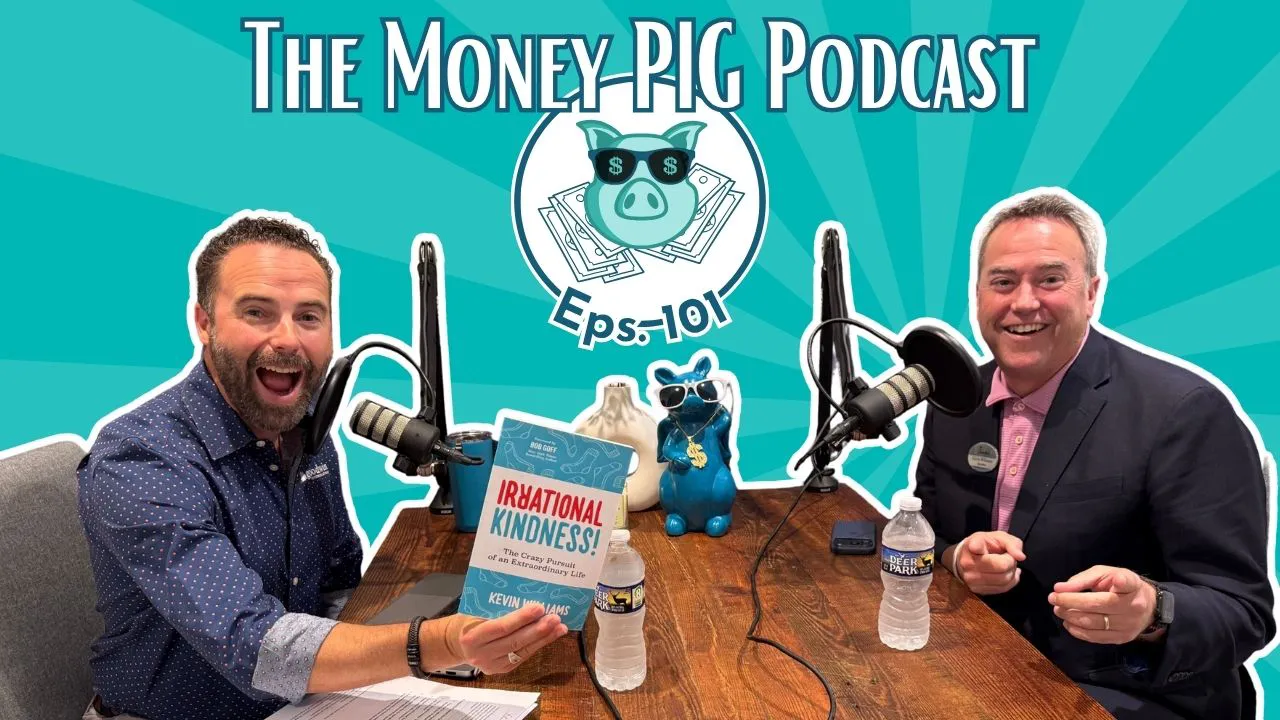
In this inspiring episode, host Tim Goodwin sits down with Kevin Williams — longtime Chick-fil-A Operator of three Canton, Georgia locations and author of Irrational Kindness: The Crazy Pursuit of an Extraordinary Life. Together, they explore what it really means to lead with generosity, humility, and purpose in today’s workplace.
Kevin shares stories from his journey building thriving teams where people feel seen, valued, and empowered to grow — not just as employees, but as human beings. From his signature “Coffee with Kevin” sessions to his belief that failure is one of life’s best teachers, Kevin invites us to rethink leadership as an act of service.
Listeners will learn how generosity can be both irrational and impactful—how giving time, grace, and opportunity can create loyalty, drive excellence, and transform company culture from the inside out.
This conversation reminds us that generosity isn’t a line item on a budget — it’s a way of life that multiplies meaning, both in business and beyond.
🎧 Key Takeaways:
- What “Irrational Kindness” looks like in real leadership.
- How to create a culture of trust and purpose.
- Turning failure into growth and grace.
- Sustaining generosity without burnout.
- Practical steps any leader can take to lead with heart.
Join us as we explore how generosity — in the workplace and in life — creates ripple effects that extend far beyond profit and performance.
The following transcript of the podcast audio was software generated, and not reviewed for accuracy. Therefore the transcript below should not be used without verifying the validity and accuracy of its content. Please contact Goodwin Investment Advisory with any questions.
Tim (host): Welcome to the Money PIG Podcast, presented by Goodwin Investment Advisory, where our mission is to lead you to financial P.I.G.—peace, independence, and generosity. I’m your host, Tim Goodwin. Welcome back to the Money PIG Podcast. We’re super excited today to have the one, the only Kevin Williams. Kevin, so excited to have you here today.
Kevin: Let’s go.
Tim: Kevin is a Chick-fil-A operator—and what’s really special about Kevin is, well, one store is not enough for him. Kevin has three stores in Cherokee County, Georgia, and he’s also the author of Irrational Kindness. This is a book that we read as a team—we do a couple team reads a year—and I remember getting in touch with you and having you come by and surprise the team on our last book discussion. Weren’t we at Moxy Burger or something?
Kevin: Oh my gosh—yes!
Tim: It was a really cool surprise, and we were so inspired by the book. I’ve got a bio here I want to read: Kevin is known for leading with generosity, hospitality, and humility. He believes in seeing the human behind the role, turning failure into growth, and building a culture where kindness isn’t just rational—it’s transformational. Through his leadership, his book, and his community work with the New Ground Foundation, Kevin lives out a model of what it looks like to be a generous employer. We’re super excited to have you here today.
Kevin: Well, Tim, thanks for having me in. You lead this direction too. I’m glad we get to cheer each other on, inspire each other, and walk together in the good and the bad. I’m grateful for our friendship.
Tim: Maybe share something the audience doesn’t know about you. We gave a little bio on your work—what else?
Kevin: As I look forward, I really want to be a great grandfather one day. Not a “great-grandfather,” but a terrific grandfather—eventually a great-grandfather! I get inspired by being there for my kids and my grandkids. That’s really where my brain goes—making sure I’m checking the box on availability. I’ll miss things with people sometimes; I’m going to fail people; I won’t live up to what everyone wants between work and life. But I don’t want to miss being available to my family. I might get a B or C in other things—I want an A in that role.
Tim: That’s great, especially since we’ll talk about being employers and the workplace. You care a lot about your team and still prioritize family. I was just talking with a mentor who shared how grateful he is for his parents—that’s like straight up a Ten Commandments thing: honor your father and mother and it comes with a promise.
Kevin: Being available was important to my parents— I watched them live it out. They were always there. I want to do the same.
Tim: Quick shift here—do you like cheese?
Kevin: I like cheese.
Tim: Me too. My favorite kind of cheese is one I keep around for emergencies.
Kevin: Please tell me it’s the squirt-can kind on a Ritz cracker.
Tim: Is that your favorite?
Kevin: That’s pretty good—cheese whiz on a Ritz cracker!
Tim: You need to talk to the Chick-fil-A folks who invent sandwiches—“We need a cheese whip layer between a bun made of Ritz crackers!”
But my favorite emergency cheese? Queso. (Just in case… 🙃)
Kevin: (Laughs) Your delivery was so quick I missed it!
Tim: All right, dad jokes aside—let’s jump into your book. Super inspiring. How many employees do you have?
Kevin: Between 400 and 450 at all times.
Tim: Wow. So it oscillates—some days you might hire 50 or lose 50.
Kevin: It depends on the season—lots of high school and college team members, so there’s natural turnover when school schedules shift. I was on front counter the other day; an awesome person with a beautiful smile was there and I said, “We need that smile at Chick-fil-A—apply here!” She said, “I do work here.” I was like, “Oh no!” That’s the problem with 400+ people—she was in regular clothes and I didn’t recognize her out of uniform. But we have phenomenal people who care about customers, which I love.
Tim: That sets Chick-fil-A apart. Let’s get into basics: your book is Irrational Kindness: The Crazy Pursuit of an Extraordinary Life. What does that mean? What does irrational kindness look like?
Kevin: It’s looking at things differently. Jesus modeled this—grace, the last shall be first, caring for orphans and the poor—seeing the world in a new way. That intrigues me: how can we see our work and kindness in a new way? It doesn’t mean being walked over or abandoning your values; it means you don’t have to be “right” in everything. Walk alongside people. We don’t all need to be “health inspectors” in each other’s lives, pointing out failures all the time. We can be slow to react. Even when a guest isn’t friendly or is distracted on their phone, it doesn’t mean they’re a jerk—something could be going on. Viewing interactions through a different lens—team members and customers—changes us. Most of the time it’s a “me problem.” When I change my perspective, I see differently.
Tim: My family and I were just talking about this. We watched a TED Talk called “How to Not Take Things Personally.” The speaker became a soccer ref to train himself! He shares exactly what you said: it’s often not about you; empathize. And if you are taking it personally—ask why. Pride? Over-importance?
Kevin: Assume the best. We often assume the worst. Driving, someone pulls out in front of you—can we assume the best? Look at the world a little differently. I call it “irrational” because it’s not the default reaction. The brain thinks hundreds of thousands of thoughts a day—something like 80% are negative. We battle to express gratitude. What’s “rational” is “that person’s a jerk.” What’s “irrational” is “maybe they didn’t see me; maybe they need to get somewhere.”
Tim: Opportunity every day—how will we see it? You mentioned curiosity slowing things down. Not everything is a fire.
Kevin: Exactly. Most things are important, but not on fire. Slow down, get curious about how we got here. Teams can get frustrated because they’ve seen something simmer and feel it’s time to react, but I want to understand it better before reacting: “I hear you—can we understand it a little better?”
Tim: I tell my kids, “Be interested instead of interesting.” The most interesting person in the room is the one who’s interested. That’s curiosity. I saw you do this at your Chick-fil-A 5K. There were thousands of people there, and you stopped, got to know my daughter Kanan. You asked a few great questions—found what she loves—and she lit up. You connected in seconds. I was inspired.
Kevin: She’s awesome. The next generation really wants to do something impactful. They’re distracted by a million things, but when you tap into curiosity—what makes them tick—it’s fun to discover.
Tim: Back to employer mode—irrational kindness at work. You’ve said slow down, be curious, don’t overreact. What are more examples of making sure your team manifests irrational kindness?
Kevin: For us, the guest is number one. We never take a guest for granted. People think “Chick-fil-A is busy; open the doors and they come.” I don’t think that way. When we open, that first guest chose us—keep that freshness of mind. They’re inviting us to serve them—great food, but also their time and money. How do we get a 16-year-old to see the customer that way? It’s fast-paced. So we teach that systems and standards help—like saying “my pleasure”—but you have to mean it. We teach squaring shoulders, eye contact, enthusiastic tone—head and heart aligned.
It’s easy to paint big brushstrokes—faith, business philosophy, family—but the work is in details: walking alongside, practicing, giving safe places to get out of comfort zones, room to fail and be a little wonky. That’s how skills are learned.
Tim: You’ve got 400–450 employees. You mentioned systems and culture—and “Coffee with Kevin.” Explain what it is, why you do it, and what you’ve seen.
Kevin: It’s a system to make sure I connect after the overwhelming first-day orientation. We bring folks back when their brain is fresher. I cheer them on: remind them they’re unique, created original by God; lean into their gifts while aligning with our purpose—hospitality, great food, second-mile service. I teach on failure too—share failures, even silly ones like my sweaty armpits photo when opening our second location. We’re going to mess up a ton—it’s okay. Take the power away from the irritation. Create a safe place and a place of challenge. Irrational kindness isn’t donuts and being sweet; it’s care and growth. We expect your best. Whether you retire with us or go be a mechanic, nurse, teacher—leave better than when you started.
Tim: You’ve said failure is a gift. Expand on that.
Kevin: Maybe because I fail a lot! I’ll get overwhelmed, make a bad decision, beat myself up. But every day is a chance to take a deep breath—today is a new day. Some days in business I think I’ve got it all figured out; the next day I feel like I have no idea. Sleep helps. Ask God for clarity. Shut off distractions. Say “no” to some things. (Our buddy Bob Goff says he says no every Thursday!)
Tim: Practical takeaways: say a listener has some influence over their workspace—not 450 employees, not writing books—but what first steps can help create a more generous work environment?
Kevin: Pause and look around—what we call the “Kindness Pause.” Refresh your view of people. Someone who was “wacky” a year ago might not be today. See people where they are and where they’re headed—not just where they’ve been. That’s how you find and keep people.
During the “Great Resignation” in 2021 when help-wanted signs were everywhere, we did something different. Instead of another “Now Hiring” sign, we put up “We’re Not Hiring” and bought werenothiring.com. It differentiated us and actually brought in more applications. Sometimes you need to stop and look at problems from a new angle. If an Arby’s opens next door, they’ll find people because they’ll go at it with intensity. So how can we look at it differently?
Tim: I’m going to give you a special segment—New Ground is very special to you and your wife, Gwen. Share more about it.
Kevin: We started New Ground Foundation. We’ve had a 15-acre property for about 10 years, dreaming around foster/adopt parenting as our target. Love is vital, but sometimes you need skills to go with love—marriage, finances, faith, parenting. When things go sideways, we can feel alone or embarrassed. New Ground walks alongside families doing hard things—building community so people can lean on each other. “New ground” is a farming term—clear-cut soil becomes rich, fertile ground for growth. That’s what we want this space to be.
Tim: I’m grateful to have optics into it and to see what God does through you two. I love ending with gratitude. I just want to say: God has you uniquely positioned in this community. At your New Ground opening, you brought pastors from multiple churches, philanthropists, authors, business leaders—an incredible cross-section. I’m in awe of what God is doing through you. Keep going—we’re cheering you on.
Kevin: Thank you, Tim. We’re doing it together. Let’s take it one day at a time and not lose the opportunity God’s given us in this season. Whatever you’re doing, make the world a little better than you found it. We’ll mess up a ton—but that’s part of the story. We’ll keep rolling and see where God takes it.
Tim: Thanks for coming today. We call it the Money PIG Podcast because PIG is part of our mission—peace, independence, generosity. Today we focused on generosity. Have you ever been to the Pink Pig in Atlanta?
Kevin: Absolutely!
Tim: One time we told my father-in-law we were going to ride the Pink Pig and he thought we were going to a barbecue restaurant. (Laughs) Maybe we should start serving barbecue to guests!
Tim: Thanks again, Kevin, for coming. We’re grateful to have you here, and thank you all for listening. We’ll catch you next time. Bye-bye.
Outro/Disclaimer: Thank you for tuning in to the Money PIG Podcast. We hope you enjoyed today’s episode. To stay updated on new episodes, be sure to subscribe wherever you listen to podcasts. If you found value in today’s discussion, we’d greatly appreciate a rating and review. If you have any questions about the topics we covered, visit us at goodwininvestment.com and reach out. This episode is produced by evance.net. This podcast is provided for informational purposes only and should not be considered as investment advice, a solicitation to buy or sell any financial products, securities, digital assets, or other investment vehicles, nor as a basis for making any financial decisions. Goodwin Investment Advisory is a registered investment adviser with the SEC, CRD number 131193. Please note that the host and our guests may personally own securities, digital assets, or other investments mentioned in this podcast. Investments carry risk and are not guaranteed unless stated otherwise. We strongly recommend consulting with a qualified financial adviser, tax professional, insurance professional, and/or legal professional before implementing any strategies discussed in this episode. Lastly, past performance is not indicative of future results.
The Money PIG podcast is hosted by Reid Trego. Goodwin Investment Advisory is a Registered Investment Advisory firm regulated by the Securities and Exchange Commission in accordance and compliance with securities laws and regulations. Goodwin Investment Advisory does not render or offer to render personalized investment or tax advice through the Money PIG podcast. The information provided is for informational purposes only and does not constitute financial, tax, investment or legal advice.
For personalized financial guidance, schedule an intro call with our team at Goodwin Investment Advisory in Woodstock, Georgia . Our CFP® professionals can provide advice and help you navigate how to invest your wealth and plan for your retirement. We’d love to help you live out your legacy! To learn more about the benefits and services we offer click here.
Goodwin Investment Advisory is an SEC-registered investment adviser (CRD #131193), and this episode is produced by evanced.net. This podcast is for informational purposes only and is not investment advice or a recommendation to buy or sell any financial products, securities, digital assets, or other investments. It should not be used as the basis for any financial decisions. The host and/or guests may personally hold investments mentioned in this episode. All investments involve risk, and past performance does not guarantee future results. Please consult with a qualified financial adviser, tax professional, and attorney before taking action on any information shared.
Share This Story, Choose Your Platform!
Related Posts