

Dec 1, 2025
The Markets
A change of direction…
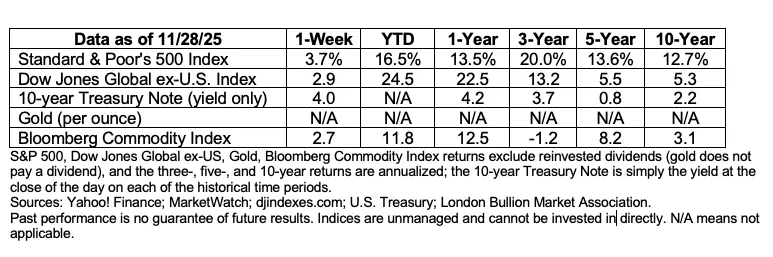
Stock markets in the United States reversed course last week, with two major indices eking out gains for the month, reported Callum Keown of Barron’s. There were some other important changes last week that also may affect markets and investors. Here’s a recap:
New expectations for rate cuts. Stock markets gained as the probability that the Federal Reserve (Fed) will lower the federal funds rate in December increased from 30 percent on November 19 to above 85 percent last week.
“The shift in rate sentiment started after last week’s delayed September jobs data, which painted a mixed picture. It then picked up steam on Friday after New York Fed President John Williams signaled he sees room for a reduction ‘in the near term’ amid labor market softness,” reported Edward Bolingbroke and Ye Xie of Bloomberg.
Signs of weakness in the housing market. The move from a seller’s housing market to a buyer’s housing market may have begun, reported Prashant Gopal of Bloomberg. In September, price growth slowed for the eighth month in a row as demand for homes fell amid economic uncertainty and affordability issues.
“Homesellers in the U.S. are yanking listings off the market, as the nation’s real estate sector stagnates. Nearly 85,000 sellers removed their properties in September, the highest number for that month in eight years, according to Redfin. The number of stale listings — those sitting on the market for 60 days or more — jumped to the highest level for any September since 2019.”
An unanticipated credit risk for lenders. A Supreme Court decision legalized state-level sports gambling in 2018 and it’s affecting credit scores in states where online sports gambling is allowed, according to research from UCLA. Deteriorating consumer financial health could lead to problems for lenders. Nick Devor of Barron’s cited analysts at Bank of America who wrote:
“For lenders the increasing availability of online betting markets raises the potential for revolving debt spikes, accelerated defaults, and higher charge-off rates, particularly among subprime borrowers…a new risk for lenders, one that they have not had to deal with historically and underwriting models may need to be adapted.”
Stock markets in the United States moved higher over the shortened holiday week, “ending a volatile November and [capping] off a strong Thanksgiving week,” reported Barron’s. “In a remarkable comeback, the Dow closed 0.3 [percent] higher for November. It was down 3.8 [percent] just eight days ago.” Yields on U.S. Treasuries were mixed.
TIS THE SEASON! The holiday shopping season gets underway this week, and expectations are high. The National Retail Federation (NRF) looks at a bunch of economic factors – consumer spending, disposable personal income, employment, wages, inflation, and monthly retail sales – to estimate how much people will spend over the winter holidays. This year, the forecast suggests sales will top $1 trillion.
“American consumers may be cautious in sentiment yet remain fundamentally strong and continue to drive U.S. economic activity…We remain bullish about the holiday shopping season and expect that consumers will continue to seek savings in nonessential categories to be able to spend on gifts for loved ones,” explained NRF President and CEO Matthew Shay.
The gift shift
The Currency reported on a recent survey, called the Going Rate, that explored how Americans think about gift giving and spending. When responses were tallied, it found that:
86 percent Believe gifts can be meaningful without being expensive.
75 percent Expect gifts will be more expensive this year because of tariffs and inflation.
60 percent Think gift culture has gotten “out of hand”.
58 percent Have a gift budget.
56 percent Buy gifts throughout the year to spread out the cost.
48 percent Experience gift fatigue.
33 percent Are adopting no-gift policies.
Fifty-five percent of millennials, 50 percent of Gen Z, and 28 percent of baby boomers would rather give the gift of time and shared experience. They believe their presence is the real gift. Respondents who plan to give gifts expect to spend about $64 per person, on average.
THIS IS YOUR BRAIN ON TECHNOLOGY. Pocket computers are mighty helpful. Smartphones let us make phone calls, listen to music, debunk mistaken information, conduct banking transactions, and do a lot more! It’s a fact that people spend a lot of time on their phones.
“According to recent data, the average person spends 4 hours and 37 minutes on their phone every day. That’s the equivalent of over 1 day per week or 6 days per month. Across a year, that’s approximately 70 days spent looking at a phone…On average, people check their phones 58 times per day,” reported Fabio Duarte on Exploding Topics.
While smartphones are convenient and make life easier, they may hurt our ability to concentrate and pay attention, according to a paper published in Scientific Reports. Researchers asked 20– to 34-year-olds to complete a test. Those who were tested without their phones present worked faster and had significantly better performance than participants who were tested with their phones in the room.
“[The study] provides evidence that even the mere presence of one’s smartphone consumes cognitive resources, without willingly shifting attention or actively using the smartphone. In the test situation, there was no visible interaction with the smartphone, as the smartphone was not looked at or picked up.”
No matter what type of device people are using, too much screen time can affect brain health. A recent study found that too much screen time can thin “the cerebral cortex, the brain’s outermost layer responsible for processing memory and cognitive functions, such as decision-making and problem-solving,” reported Mary Grace Descourouez in Stanford Lifestyle Medicine. In addition, “Light from the screen can delay melatonin release from the brain’s pineal gland, impacting the body’s natural circadian rhythm and causing difficulty sleeping.”
With smartphones, as with so many things, moderation is a virtue.
WEEKLY FOCUS – THINK ABOUT IT
“What is the world’s biggest city? To an alien gazing down from space, ignoring political boundaries and just mapping contiguous areas of high population density, the answer would be clear: the Pearl River Delta, a chain of southern Chinese cities that have fused into one vast sprawl. Its population is projected to reach 73m people in 2026, just as a regional high-speed railway network, to bind it together, is due to be completed.”
– The Economist, The World Ahead, Mapping 2026
Disclosures and resources:
* These views are those of Carson Coaching, not the presenting Representative, the Representative’s Broker/Dealer, or Registered Investment Advisor, and should not be construed as investment advice.
* This newsletter was prepared by Carson Coaching. Carson Coaching is not affiliated with the named firm or broker/dealer.
* Government bonds and Treasury Bills are guaranteed by the U.S. government as to the timely payment of principal and interest and, if held to maturity, offer a fixed rate of return and fixed principal value. However, the value of fund shares is not guaranteed and will fluctuate.
* Corporate bonds are considered higher risk than government bonds but normally offer a higher yield and are subject to market, interest rate and credit risk as well as additional risks based on the quality of issuer coupon rate, price, yield, maturity, and redemption features.
* The Standard & Poor’s 500 (S&P 500) is an unmanaged group of securities considered to be representative of the stock market in general. You cannot invest directly in this index.
* All indexes referenced are unmanaged. The volatility of indexes could be materially different from that of a client’s portfolio. Unmanaged index returns do not reflect fees, expenses, or sales charges. Index performance is not indicative of the performance of any investment. You cannot invest directly in an index.
* The Dow Jones Global ex-U.S. Index covers approximately 95% of the market capitalization of the 45 developed and emerging countries included in the Index.
* The 10-year Treasury Note represents debt owed by the United States Treasury to the public. Since the U.S. Government is seen as a risk-free borrower, investors use the 10-year Treasury Note as a benchmark for the long-term bond market.
* Gold represents the 3:00 p.m. (London time) gold price as reported by the London Bullion Market Association and is expressed in U.S. Dollars per fine troy ounce. The source for gold data is Federal Reserve Bank of St. Louis (FRED), https://fred.stlouisfed.org/series/GOLDPMGBD228NLBM.
* The Bloomberg Commodity Index is designed to be a highly liquid and diversified benchmark for the commodity futures market. The Index is composed of futures contracts on 19 physical commodities and was launched on July 14, 1998.
* The DJ Equity All REIT Total Return Index measures the total return performance of the equity subcategory of the Real Estate Investment Trust (REIT) industry as calculated by Dow Jones.
* The Dow Jones Industrial Average (DJIA), commonly known as “The Dow,” is an index representing 30 stock of companies maintained and reviewed by the editors of The Wall Street Journal.
* The NASDAQ Composite is an unmanaged index of securities traded on the NASDAQ system.
* International investing involves special risks such as currency fluctuation and political instability and may not be suitable for all investors. These risks are often heightened for investments in emerging markets.
* Yahoo! Finance is the source for any reference to the performance of an index between two specific periods.
* The risk of loss in trading commodities and futures can be substantial. You should therefore carefully consider whether such trading is suitable for you in light of your financial condition. The high degree of leverage is often obtainable in commodity trading and can work against you as well as for you. The use of leverage can lead to large losses as well as gains.
* Opinions expressed are subject to change without notice and are not intended as investment advice or to predict future performance.
* Economic forecasts set forth may not develop as predicted and there can be no guarantee that strategies promoted will be successful.
* Past performance does not guarantee future results. Investing involves risk, including loss of principal.
* The foregoing information has been obtained from sources considered to be reliable, but we do not guarantee it is accurate or complete.
* There is no guarantee a diversified portfolio will enhance overall returns or outperform a non-diversified portfolio. Diversification does not protect against market risk.
* Asset allocation does not ensure a profit or protect against a loss.
* Consult your financial professional before making any investment decision.
Sources:
https://www.barrons.com/articles/sports-betting-risk-enders-bofa-analysts-ef87e724 or go to https://resources.carsongroup.com/hubfs/WMC-Source/2025/12-1-25-Barrons-Stocks-Jump-%201.pdf
https://www.cmegroup.com/markets/interest-rates/cme-fedwatch-tool.html or go to https://resources.carsongroup.com/hubfs/WMC-Source/2025/12-1-25-CME-Group-FedWatch%20-%202.pdf
https://www.bloomberg.com/news/articles/2025-11-25/traders-crowd-into-fed-futures-targeting-a-december-rate-cut or go to https://resources.carsongroup.com/hubfs/WMC-Source/2025/12-1-25-Bloomberg-Traders-Crowd-Into-Fed-Futures%20-%203.pdf
https://www.bloomberg.com/news/articles/2025-11-25/us-home-price-growth-slowed-in-september-as-buyers-pulled-back or go to https://resources.carsongroup.com/hubfs/WMC-Source/2025/12-1-25-Bloomberg-US-Home-Price%20-%204.pdf
https://www.bloomberg.com/news/articles/2025-11-25/us-homesellers-pull-stale-listings-off-market-as-interest-fades or go to https://resources.carsongroup.com/hubfs/WMC-Source/2025/12-1-25-US-Home-Sellers-Pull%20-%205.pdf
https://www.anderson.ucla.edu/sites/default/files/document/2025-05/Hollenbeck_The_Financial_Consequences_of_Legalized_Sports_Gambling.pdf
https://www.barrons.com/articles/sports-betting-risk-enders-bofa-analysts-ef87e724 or go to https://resources.carsongroup.com/hubfs/WMC-Source/2025/12-1-25-Barrons-Sports-Betting-a-Risk%20-%207.pdf
https://home.treasury.gov/resource-center/data-chart-center/interest-rates/TextView?type=daily_treasury_yield_curve&field_tdr_date_value_month=202511
https://explodingtopics.com/blog/smartphone-usage-stats
https://www.nature.com/articles/s41598-023-36256-4
https://lifestylemedicine.stanford.edu/what-excessive-screen-time-does-to-the-adult-brain/
https://www.economist.com/the-world-ahead/2025/11/12/eight-trends-to-watch-explained-with-maps or go to https://resources.carsongroup.com/hubfs/WMC-Source/2025/12-1-25-Economist-Eight-Trends-to-Watch%20-%2012.pdf
Disclosure – All investment carries risk, and we cannot guarantee performance or results. Past performance does not guarantee future results. GIA does not earn any compensation from any of the non-GIA links provided in these resources. The market insights, podcast, blogs, book recommendations, self improvement thoughts, food recipes and activities are based on our perspectives and experience, and may not apply to your unique situation or be appropriate for your health and wellness. We are not aware of any conflicts of interest relating to any testimonials or endorsements. Please contact us for any questions relating to the content above, or to discuss how we can support you in your specific situation, and help you to reach your financial and personal goals.
Share This Story, Choose Your Platform!
Related Posts